

Relational, issue-led professional development to address the complex operational challenges facing your setting.
Focused Support for the Issues You Lead
When specific, complex challenges arise in your school or college, leaders need targeted, practical spaces to reflect, collaborate, and plan. Our two-hour live online masterclasses offer evidence-informed insights, progressive case studies, and structured application tasks designed to help you build relational, accessible, and safe responses.
No Prerequisites Required: Open to all leaders. You do not need to have attended Course 1, Course 2, or any prior TICS training to book.
Distributed Leadership: We strongly encourage SMHLs to attend alongside a relevant colleague (such as your SENCO, DSL, Attendance Lead, or Behaviour Lead) to foster shared understanding and distributed responsibility.
Setting-Specific Application: Content and practical tasks are differentiated for primary, secondary, further education (FE), special schools, and alternative provision (AP).
Investment & Flexible Bundles
Individual sessions can be booked independently, or combined into cost-effective bundles for a named participant:
Single Masterclass: £25 + VAT per person
3-Masterclass Bundle: £65 + VAT (Save £10)
6-Masterclass Bundle: £120 + VAT (Save £30)
Note: Masterclass bookings include session-specific implementation tools, digital resources, and a certificate of attendance. The textbook and reflective follow-up are exclusive to Main Courses 1 and 2.
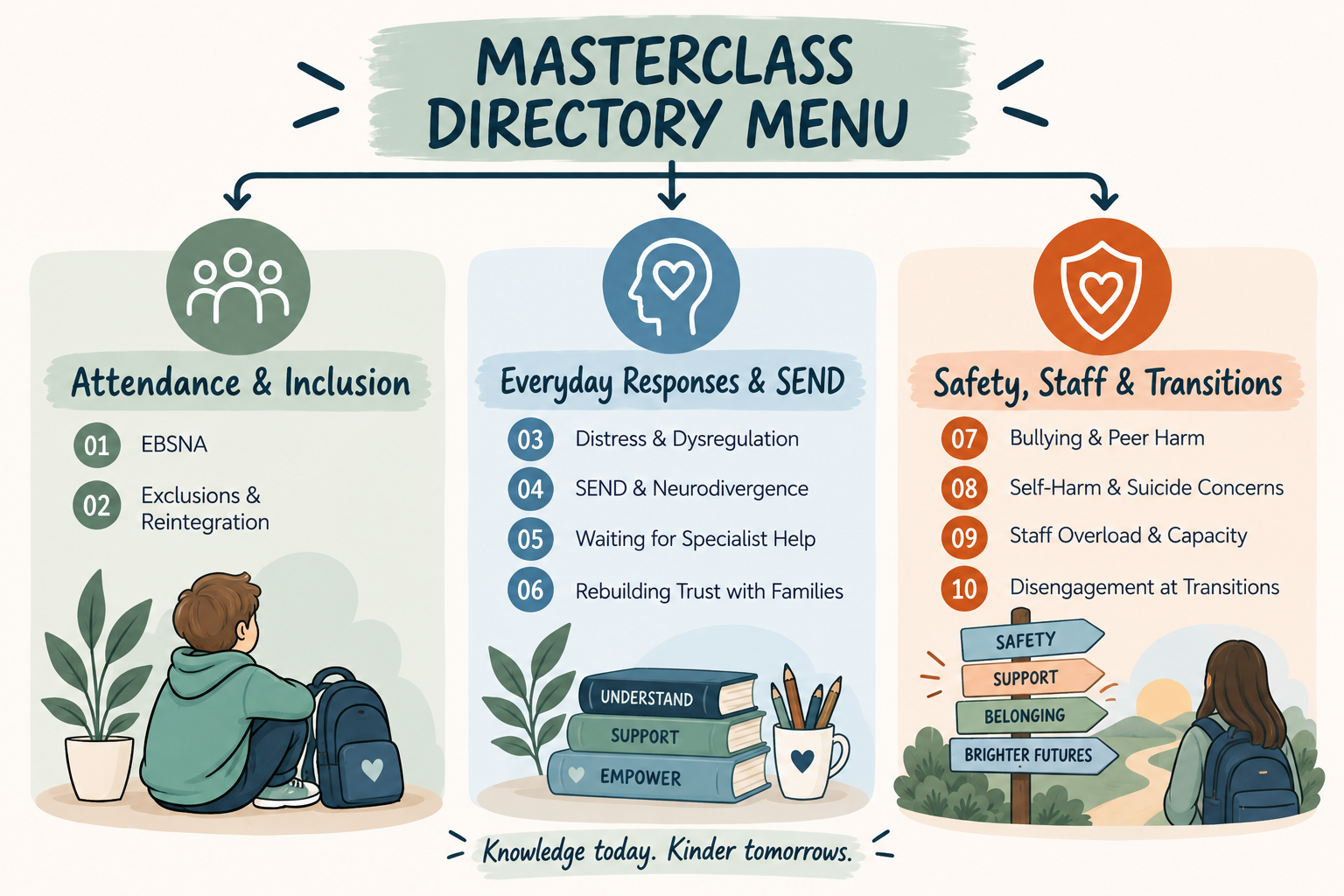
Move beyond raw attendance figures to understand emotionally based school non-attendance (EBSNA) through a pupil-centred, relational lens. Explore how attendance, SEND, pastoral, and safeguarding teams can build a shared understanding with the learner and family.
Learning Outcomes: Review how distress and environmental barriers are explored; clarify the SMHL's contribution to coordinated support; plan adjustments that support emotional safety and access to learning.
Practical Takeaway: Whole-setting EBSNA response map and pupil-centred support-planning template.
Recommended Colleague to Join You: Attendance Lead, SENCO, or Pastoral Lead.
Examine how the SMHL can contribute to prevention, inclusive decision-making, and meaningful reintegration alongside senior and behaviour leaders. Explore repeated incident patterns and missed opportunities to respond differently, supporting safety without promising that training alone eliminates exclusions.
Learning Outcomes: Review suspension and disengagement patterns; identify where coordinated adjustments strengthen prevention; plan reintegration that changes ongoing support and relationships.
Practical Takeaway: Inclusion and exclusion review tool with a structured reintegration-planning framework.
Recommended Colleague to Join You: Senior Leader, Behaviour Lead, SENCO, or Designated Teacher.
Move beyond isolated de-escalation techniques to examine systemic patterns around repeated incidents. Explore how adult responses, communication, and environmental demands can align compassionate, relational support with clear boundaries and staff safety.
Learning Outcomes: Use structured incident review to explore triggers and adult responses; identify changes to routines to reduce escalation; strengthen post-incident repair without reducing pupils to their behaviour.
Practical Takeaway: Incident-review framework and shared staff-response planning tool.
Recommended Colleague to Join You: Behaviour Lead, SENCO, Pastoral Lead, or Phase Lead.
Adopt a trauma-informed and neurodiversity-affirming approach to recognise needs that are missed, misunderstood, or unassessed. Focus on curiosity, masking, sensory demands, and communication differences rather than forcing an "either-trauma-or-neurodivergence" explanation.
Learning Outcomes: Review how pupil/family perspectives inform understanding of less visible distress; examine environments for barriers to safety; clarify collaborative responsibilities with the SENCO.
Practical Takeaway: Accessibility and unmet-needs review tool with prompts for coordinated support planning.
Recommended Colleague to Join You: SENCO, Inclusion Lead, Learning-Support Lead, or Pastoral Lead.
Organise structured, appropriate interim support while a pupil awaits specialist external input or transitions between services. Focus on internal coordination, access to learning, and escalation pathways without asking school staff to replace clinical treatment.
Learning Outcomes: Map existing provision, referral pathways, and gaps; plan proportionate interim support with agreed review points; check how staff recognise and escalate changing concerns.
Practical Takeaway: Interim-support and pathway-mapping tool with named ownership and review prompts.
Recommended Colleague to Join You: DSL, SENCO, Pastoral Lead, or External Service Coordinator.
Examine how school communication, meetings, and processes can strengthen partnership or deepen mistrust. Work through disagreements regarding attendance, behaviour, and unmet needs, learning to listen deeply and explain decisions without blame.
Learning Outcomes: Review language and processes that leave families feeling unheard; structure meetings that clarify perspectives and shared actions; plan accessible, boundary-respecting communication.
Practical Takeaway: Collaborative family-meeting framework and communication-review checklist.
Recommended Colleague to Join You: Family Liaison Lead, Attendance Lead, SENCO, DSL, or Pastoral Lead.
Connect individual support with the wider conditions that shape pupils' experiences of safety. Examine reporting routes, adult responses, peer culture, and online/in-person harm to ensure wellbeing interventions do not replace addressing harm directly.
Learning Outcomes: Review reporting accessibility and trust; connect individual support with action on peer culture and safeguarding; plan long-term safety reviews using pupil feedback.
Practical Takeaway: Pupil-safety and reporting review tool with action-planning prompts.
Recommended Colleague to Join You: DSL, Inclusion Lead, Anti-Bullying Lead, Pastoral Lead, or Digital Safety Lead.
A carefully bounded leadership masterclass on preparedness, institutional responsibilities, and team coordination. Review the interface between the SMHL, DSL, senior leaders, and specialist services. (Note: This is not clinical risk-assessment or therapy training.)
Learning Outcomes: Clarify decision leadership and access to local response procedures; review readiness for disclosures and escalation; plan ongoing coordinated support without managing risk alone.
Practical Takeaway: Leadership responsibilities map and local preparedness checklist.
Recommended Colleague to Join You: DSL, Deputy DSL, Senior Leader, or Pastoral Lead.
Review the organisational conditions that shape staff capacity to provide consistent, relational support. Distinguish between isolated wellness initiatives and structural changes to workload, boundaries, and post-incident debriefing.
Learning Outcomes: Identify pressures created by unclear roles and competing expectations; review post-incident staff support and supervision options; develop realistic proposals for shared responsibility.
Practical Takeaway: Staff-support capacity review tool and leadership proposal template.
Recommended Colleague to Join You: Senior Leader, Staff Wellbeing Lead, HR Lead, or Line Manager.
Plan continuity of relationships, information, and support when pupils move between classes, phases, settings, or post-16 pathways. Focus on supported participation and tracking actual engagement long after a handover form is completed.
Learning Outcomes: Identify transition points where trust or learning access is interrupted; use learner/family perspectives to plan named responsibility; build post-transition follow-up checks.
Practical Takeaway: Transition and continuity-of-support planning tool with post-transition review prompts.
Recommended Colleague to Join You: Transition Lead, SENCO, Attendance Lead, Designated Teacher, or Post-16 Lead.
