
Why Behaviour Policies Often Fail Vulnerable Children: Understanding behaviour through trauma, neurodevelopment and relational safety
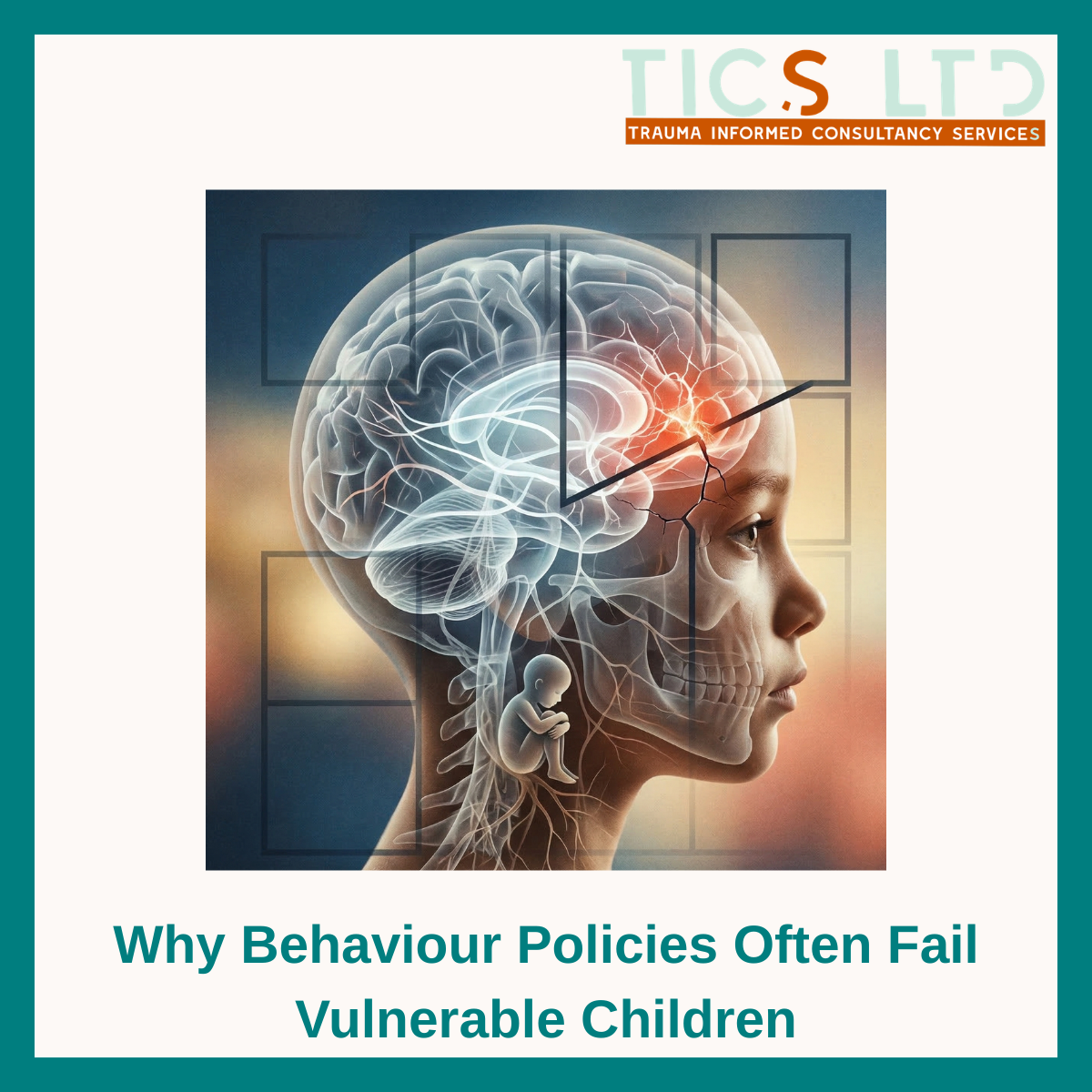
Behaviour policies sit at the heart of most school systems. They are designed to establish expectations, maintain order and ensure that learning environments remain safe and predictable. In many schools, behaviour frameworks are structured around consistent responses to rule-breaking, often involving a graduated system of warnings, sanctions and rewards.
For many pupils, these systems function reasonably well. Clear expectations and predictable consequences can help children understand the boundaries of behaviour within school environments. However, for a significant number of vulnerable pupils, particularly those with care experience or social worker involvement, traditional behaviour policies often fail to produce the intended outcomes (Carter, 2025). Instead of improving behaviour, they can inadvertently contribute to cycles of misunderstanding, escalation and exclusion (Ellis et al., 2024).
Understanding why this occurs requires us to consider how adversity shapes development and how school systems interact with those developmental experiences.
The Developmental Impact of Adversity
Children who enter care or who come to the attention of social care services often have histories characterised by instability, stress or trauma (Tumlin et al., 2023). Experiences such as neglect, domestic abuse, parental mental illness, substance misuse or family breakdown can significantly affect early development (Najman et al., 2022).
During childhood, the brain develops rapidly in response to environmental experiences. When children grow up in unpredictable or threatening environments, their stress response systems may become chronically activated (Duda et al., 2025). This can influence a range of neurological processes associated with emotional regulation, attention and impulse control.
These developmental adaptations are not signs of weakness or poor character. Rather, they represent the brain’s attempts to survive in environments where safety cannot be assumed (Peckham, 2023). However, when children with these adaptations enter school systems designed primarily for neurotypical development, difficulties often arise.
Behaviour policies typically assume that pupils can regulate their emotional responses, remember instructions, interpret social cues and adapt their behaviour in response to consequences. For many children who have experienced adversity, these capacities may be significantly compromised.
Behaviour as Communication
One of the central principles of trauma-informed practice is the idea that behaviour communicates underlying needs (Sweeney et al., 2018). When a child becomes distressed, aggressive, withdrawn or oppositional, the behaviour often reflects an internal state that the child cannot yet express verbally.
In traditional school frameworks, behaviour is frequently interpreted through a moral lens. A pupil who disrupts a lesson may be perceived as choosing to misbehave. Sanctions are therefore applied with the expectation that the pupil will modify their behaviour to avoid future consequences.
However, when behaviour arises from emotional dysregulation rather than deliberate defiance, sanctions may have limited impact. A child whose nervous system is activated by perceived threat may not have the capacity to pause, reflect and choose a different response in the moment (Tay, 2025).
Instead, repeated punishment can reinforce feelings of shame and rejection. For children who have already experienced instability in their relationships with adults, this dynamic can deepen the belief that authority figures are unpredictable or hostile.
The Hidden Challenges of Executive Functioning
Another factor that influences behaviour among vulnerable pupils is executive functioning. Executive functioning refers to a set of cognitive processes that allow individuals to plan, organise, remember instructions and regulate impulses (Ibbotson, 2023). These skills develop gradually during childhood and adolescence, supported by stable relationships and consistent environments. However, adversity can disrupt this development (Yin et al., 2025).
Many care-experienced children struggle with executive functioning difficulties that affect their ability to navigate classroom expectations. For example, a pupil may understand a rule when it is explained but struggle to remember it in the moment. Another child may intend to complete a task but become distracted or overwhelmed before finishing.
From a teacher’s perspective, these behaviours can appear inconsistent or frustrating. A pupil who appears capable in one context may struggle in another. However, inconsistency is a hallmark of executive functioning difficulties.
When behaviour policies rely on the assumption that children can consistently control their actions, they may fail to accommodate these developmental differences.
The Relational Dimension of Behaviour
For many vulnerable pupils, relationships with adults are central to their sense of safety within school (Jerrim et al., 2025). Children who have experienced disrupted caregiving may approach authority figures with caution. Some may test boundaries repeatedly to assess whether adults will respond predictably.
This testing behaviour is often misunderstood as deliberate provocation. In reality, it can reflect a child’s attempt to determine whether an adult can be trusted.
When school responses focus solely on discipline, opportunities to build relational safety may be lost. Conversely, when adults respond with calm curiosity and consistent boundaries, trust can gradually develop.Relational safety does not mean abandoning expectations. Rather, it involves maintaining structure while acknowledging the emotional needs that underpin behaviour.
The Unintended Consequences of Punitive Systems
Many behaviour policies operate through escalating consequences designed to deter rule-breaking. While this approach can be effective for some pupils, it may have unintended consequences for vulnerable children.Repeated sanctions can reinforce negative self-perceptions. A child who frequently receives detentions or exclusions may come to see themselves as inherently “bad” or incapable of success. These beliefs can reduce motivation and increase disengagement from learning.
In more severe cases, behaviour policies can contribute to exclusion from school altogether. Children with care experience are statistically more likely to experience exclusion than their peers. Exclusion, in turn, is associated with poorer educational outcomes and increased vulnerability to exploitation. When behaviour policies repeatedly remove vulnerable pupils from classrooms, the very children who most need stable educational environments may receive the least access to them.
Rethinking Fairness in Behaviour Systems
One of the challenges schools face when adapting behaviour policies is the perception that differentiated responses may be unfair. Many educators emphasise the importance of consistency and equality in applying rules.
However, equality does not always produce fairness. Treating every pupil identically assumes that all pupils begin from the same developmental starting point. In reality, children bring very different experiences and capacities into school environments. Trauma-informed approaches recognise that fairness may require flexibility. Some pupils need additional scaffolding to succeed with behavioural expectations. This does not mean lowering standards. Rather, it involves adjusting support so that expectations become achievable.
The Role of Virtual Schools
Virtual Schools play an important role in supporting schools to develop more nuanced behaviour responses. Because Virtual School teams work across multiple educational settings, they often have a broader perspective on the challenges faced by care-experienced pupils.
Virtual School Heads and their teams can support schools by promoting trauma-informed training, encouraging reflective practice and advocating for relational approaches to behaviour. They can also facilitate conversations among educators, carers and social workers, helping schools understand the broader contexts that influence a child’s behaviour.
Moving towards Trauma-Informed Behaviour Systems
Developing trauma-informed behaviour systems requires cultural change within schools. It involves shifting from a focus on control towards a focus on understanding. Educators may begin by asking different questions when behaviour difficulties arise. Instead of asking “How do we stop this behaviour?”, they might ask “What is happening for this child that makes this behaviour necessary?”
This shift does not remove accountability. Children still need guidance, boundaries and opportunities to learn from mistakes. However, when adults respond with curiosity rather than judgement, behaviour becomes an opportunity for learning rather than punishment. Over time, this approach can help children develop the emotional regulation and relational trust necessary to thrive within educational environments.
Conclusion
Behaviour policies are essential components of school systems, but they must be responsive to the diverse developmental needs of pupils. For care-experienced children, traditional sanction-based approaches often fail to address the underlying causes of behaviour.
Trauma-informed practice offers an alternative framework, one that recognises behaviour as communication and prioritises relational safety alongside accountability.
Virtual Schools, Designated Teachers and school leaders have an important role in guiding this shift. By promoting understanding of trauma and development, they can help create behaviour systems that support rather than exclude vulnerable pupils.
When behaviour is understood in context, schools move closer to environments where every child has the opportunity to succeed.
References
Carter, H. (2025). Trauma-informed or trauma-inducing? School behaviour policies and their impact on vulnerable pupils. Emotional and Behavioural Difficulties, 1–13. https://doi.org/10.1080/13632752.2025.2598504
Duda, J. M., Keding, T. J., Kribakaran, S., Odriozola, P., Kitt, E. R., Cohodes, E. M., Zacharek, S. J., McCauley, S., Haberman, J. T., Joormann, J., & Gee, D. G. (2025). Exposure to unpredictable childhood environments is associated with amygdala activation during early extinction in adulthood. Developmental cognitive neuroscience, 74, 101578. https://doi.org/10.1016/j.dcn.2025.101578
Ellis, K., & Johnston, C. (2024). Care and education: Instability, stigma and the responsibilisation of educational achievement. Children and Youth Services Review, 156, 107319.
Ibbotson, P. (2023). The Development of Executive Function: Mechanisms of Change and Functional Pressures. Journal of Cognition and Development, 24(2), 172–190. https://doi.org/10.1080/15248372.2022.2160719
Jerrim, J. (2025). How do pupils’ feelings of school safety relate to their attendance and well-being? Longitudinal evidence from England. Cambridge Journal of Education, 55(4), 499–524. https://doi.org/10.1080/0305764X.2025.2521512
Najman, J. M., Clavarino, A. M., McGee, T. R., Middeldorp, C. M., Williams, G. M., & Scott, J. G. (2022). Do adversities experienced over the early life course predict mental illness and substance use behaviour in adulthood: A birth cohort study. Journal of psychiatric research, 155, 542–549. https://doi.org/10.1016/j.jpsychires.2022.09.020
Peckham H (2023) Introducing the Neuroplastic Narrative: a non-pathologizing biological foundation for trauma-informed and adverse childhood experience aware approaches. Front. Psychiatry 14:1103718. doi: 10.3389/fpsyt.2023.1103718
Sweeney, A., Filson, B., Kennedy, A., Collinson, L., & Gillard, S. (2018). A paradigm shift: relationships in trauma-informed mental health services. BJPsych advances, 24(5), 319–333. https://doi.org/10.1192/bja.2018.29
Tay, A. (2025). Switching minds: A theoretical model of cognitive speed gaps, emotional reactivity, and behavioural self-regulation. Complementary therapies in medicine, 95, 103273. https://doi.org/10.1016/j.ctim.2025.103273
Tumlin, K. I., Crowley, A., Turner, B., Riley, E., & Lyons, J. (2023). Detection of traumatic stress in the presence of traumatic experiences: the role of resilience factors in foster care children five years or younger. International journal of mental health systems, 17(1), 39. https://doi.org/10.1186/s13033-023-00610-w
Yin, H., Amran, M. (2025). Adverse Childhood Experiences and Executive Functioning in Chinese Adolescents: The Mediating Role of Emotional States . Open Psychol J, 18: e18743501413673. http://dx.doi.org/10.2174/0118743501413673250806080123