
Trauma and Homelessness: Two Stories Intertwined

Trauma and homelessness are tightly interwoven with research shows that as many as 94% of people experiencing homelessness in England having also experienced trauma often stemming from childhood (Irving & Harding, 2022). These may include abuse, neglect, domestic violence, or time spent in care. These early experiences can shape how people engage with services, manage relationships, and regulate emotion, often making rigid or punitive systems feel unsafe or impossible to navigate.
Homelessness itself is traumatic too. The uncertainty, exposure to danger, and loss of control reinforce deep-seated survival responses. Many people experiencing homelessness describe feeling constantly “on alert,” exhausted, and disconnected; a state that can make recovery or engagement with services extremely difficult (Stedmon & Keohane, 2025).
The Scale of the Challenge: UK Homelessness in 2025
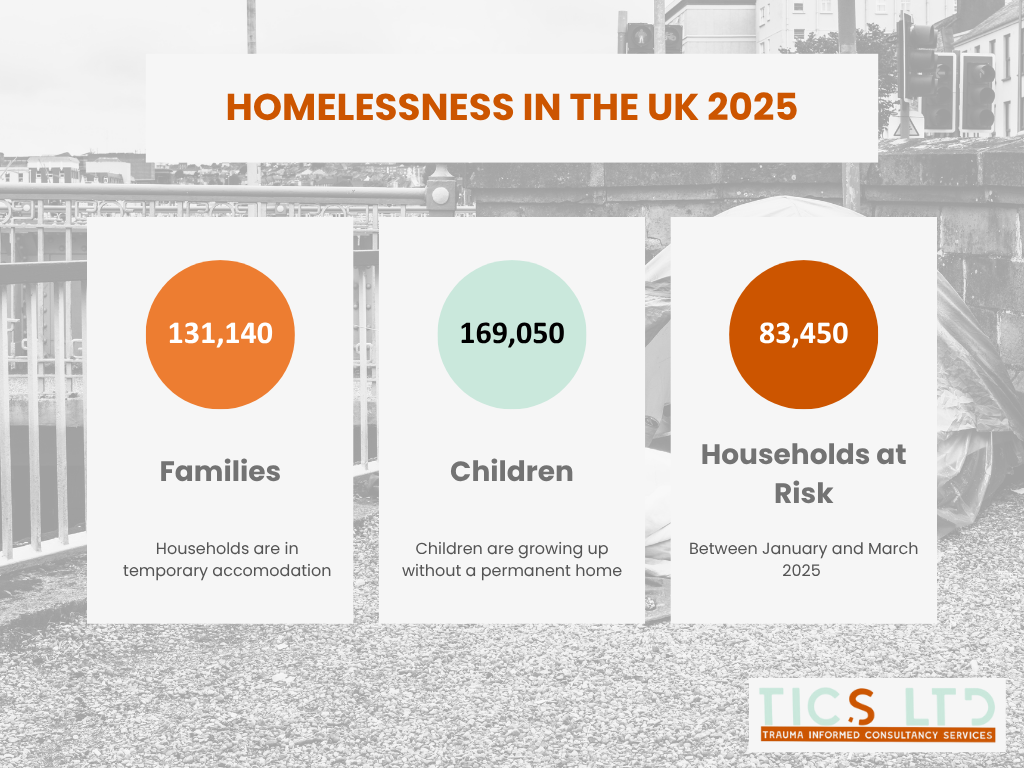
Homelessness in the United Kingdom has reached record levels, underscoring a growing national crisis that demands immediate and compassionate attention. Recent data from Homeless Link (2025) and The Salvation Army (2025) paints a stark picture of the scale and human impact of this issue. Across England, 131,140 households are currently living in temporary accommodation, the highest figure ever recorded. Within these households, 169,050 children are growing up without the security and stability of a permanent home, an experience that can have profound and lasting effects on their emotional and developmental wellbeing.
In London alone, 4,427 people were found sleeping rough in early 2025, representing an 8% increase compared to the previous year. This rise suggests that, despite ongoing efforts to tackle homelessness, more individuals are slipping through the cracks and ending up on the streets. Furthermore, between January and March 2025, local authorities assessed 83,450 households as being either at risk of homelessness or already experiencing it; a reminder that behind every statistic are people facing fear, uncertainty, and disruption in their daily lives.
These figures highlight the urgent need for trauma-informed, person-centred responses. Addressing homelessness effectively requires more than crisis management; it calls for strategies rooted in connection, stability, and early intervention. By recognising the role of trauma in many people’s experiences of homelessness, services can respond with empathy and understanding, helping individuals rebuild their lives with dignity and hope rather than simply reacting to emergencies as they arise.
What Trauma-Informed Practice Looks Like
Becoming trauma-informed is more than a set of principles or a checklist to tick off. It is a fundamental shift in culture, purpose, and power. It challenges organisations to rethink not just how they deliver services, but how they understand human behaviour, relationships, and wellbeing.
A trauma-informed approach begins with five well-known principles- safety, trust, empowerment, collaboration, and awareness of inequality and historical harm, but the true work lies in how those principles are lived and experienced within systems. The question is not simply “Are we trauma-informed?” but “Do the people we work alongside feel safe, respected, and valued when they interact with us?”
From Awareness to Systemic Change
Trauma-informed systems go beyond raising awareness about trauma as they restructure their foundations to prevent re-traumatisation and promote recovery. This requires organisations to shift from a service-delivery model focused on compliance and efficiency to one that prioritises connection, dignity, and consistency.
In practice, this means creating predictable routines, consistent relationships, and clear communication. It means understanding that change happens through relationship, not enforcement. When people have lived through instability, betrayal, or abandonment, what heals is not a form or a process but a sense that someone truly sees them and won’t walk away when things become difficult.
Organisations that embody this philosophy embed relational safety in every layer from policy to practice, leadership to environment. Every interaction becomes a message:
You matter. You are not a problem to fix. You are a person with value and potential.
Leadership and Organisational Culture
Trauma-informed systems start with leadership that models compassion and reflection. An organisation's culture will always shape the culture of care it delivers. When staff feel psychologically safe, when they are listened to and supported, they are far better equipped to provide that same sense of safety to the people they support.
Leaders set the emotional tone. They create spaces where staff can be open about what is hard, rather than punished for showing vulnerability. They replace top-down control with relational accountability recognising that people thrive when they are trusted and empowered, not managed through fear or exhaustion.
In a trauma-informed culture, supervision becomes reflective rather than corrective; mistakes are seen as opportunities for learning rather than grounds for blame. Compassion is not reserved for service users it is extended to everyone in the system. The guiding principle is simple but transformative: care for staff is care for clients.
Understanding Behaviour as Communication
A trauma-informed approach reframes how we understand behaviour. Instead of viewing actions as defiance, manipulation, or disengagement, we begin to see them as adaptations to threat, creative survival responses that once kept a person safe. This lens invites empathy over judgement. It shifts the question from “What’s wrong with them?” to “What happened to them and what’s happening now that might be making things harder?”
When services respond with curiosity rather than control, they create the conditions for emotional safety. Predictable boundaries, consistent responses, and a calm relational presence help people begin to regulate and trust again. Over time, that trust can become the foundation for genuine recovery and growth.
Designing Environments That Heal
The environments in which homelessness and support services operate can powerfully influence how safe people feel. Trauma-informed systems pay attention to the physical, sensory, and emotional atmosphere of their spaces. This might mean replacing harsh lighting and loud communal areas with calm, warm, and predictable environments. It might involve offering private spaces for conversations or ensuring that staff greet people by name. Every environmental detail, including tone of voice, layout, signage, and even the temperature of a room, communicates whether a person is valued or merely processed. When spaces are designed with intention and empathy, they become more than shelters or offices they become places of restoration and belonging.
Embedding Equity and Justice
At the heart of trauma-informed practice lies an understanding that trauma is not only personal, it is also structural and historical. Experiences of poverty, racism, discrimination, and exclusion are collective traumas that shape how people move through the world.
A trauma-informed system, therefore, cannot exist without also being an equity-centred system. It must be brave enough to look at where its own policies and processes may perpetuate harm, and willing to dismantle them. This means moving from tokenistic consultation to genuine co-production, where people with lived experience influence how services are designed, evaluated, and led.
Recognising inequality also means understanding that healing requires access to stability, housing, income, safety, and connection, not just psychological support. Trauma-informed systems advocate for justice as part of recovery. They hold a mirror to society and ask: What needs to change so that people are not re-traumatised by the very systems that are meant to help them?
Becoming Trauma-Responsive
Truly trauma-informed systems evolve into trauma-responsive systems ones that act on their understanding, not just acknowledge it. This progression means embedding trauma-awareness in commissioning, governance, and evaluation frameworks. It’s about ensuring that the relational aspects of practice (time, trust, and care) are valued and funded, not treated as decorative add-ons.
A trauma-responsive organisation designs policies that reduce bureaucracy, prioritise continuity, and make space for relational work. It measures success not only by throughput or numbers housed, but by how safe, connected, and empowered people feel within its services. In such systems, compassion becomes an expectation.
The Role of Reflection and Workforce Wellbeing
Working within trauma-exposed systems inevitably takes an emotional toll. Without care and reflection, even the most compassionate practitioners can become desensitised or burnt out. Trauma-informed systems understand that staff wellbeing is not a luxury but a form of safeguarding.
Regular reflective practice, debriefing, and peer support are essential components of a healthy workforce. They provide containment for staff who are holding the pain of others, allowing them to process rather than absorb it. This reflective culture builds resilience, sustains empathy, and prevents the kind of emotional erosion that can lead to burnout or punitive responses.
The TICS Way
At Trauma Informed Consultancy Services (TICS), we help organisations bring this ethos to life. Our work focuses on embedding compassion, curiosity, and courage at every level; from policy to practice, from the boardroom to the frontline.
We design and facilitate reflective spaces and training events where staff can pause, think, and reconnect with purpose. We support leaders to create cultures that model calm and consistency, especially under pressure. We help teams see behaviour as communication, policies as opportunities for compassion, and relationships as the true drivers of change.
Our goal is to help organisations become not just trauma-informed in name, but trauma-responsive in spirit, places where everyone, whether staff or service user, experiences safety, trust, and humanity.
Working Together to Change Systems
The homelessness sector is rich with expertise and commitment. Some of the organisations we are proud to collaborate with include:
- The Trussell Trust: a UK charity that supports a nationwide network of food banks and campaigns to end the need for emergency food by tackling the root causes of poverty.
- The Oxfordshire Homelessness Alliance: a partnership of local charities and agencies working collaboratively across Oxfordshire to prevent and end homelessness through coordinated support, housing solutions, and community engagement.
- St Mungo’s: a leading UK homelessness charity that provides outreach, housing, and recovery services to support people experiencing or at risk of homelessness, helping them rebuild their lives and move towards independence.
Healing Systems and People
Homelessness cannot be solved by housing alone. It requires joined-up, trauma-informed systems across health, social care, education, and justice. When housing departments work in partnership with mental health teams, substance misuse services, and voluntary agencies, outcomes improve. People are no longer seen as “complex cases” but as humans with stories, potential, and rights.
Every person deserves safety, belonging, and dignity. Trauma-informed practice is not a soft option; it is a strategic, evidence-based approach that creates real change. It recognises that healing happens in relationships and that trust, once broken, can be rebuilt through compassion and consistency.
If your organisation or local authority wants to explore how to embed trauma-informed principles into homelessness prevention or support services, get in touch with the TICS team. Together, we can make homelessness responses more humane, more effective, and ultimately, more hopeful.
References
Homeless Link. (2025). Number of people in temporary accommodation continues to break records. Homeless Link. Retrieved from https://homeless.org.uk/news/number-of-people-in-temporary-accommodation-continues-to-break-records/
Irving, A., & Harding, J. (2022). The prevalence of trauma among people who have experienced homelessness in England: A report for Oasis Community Housing (Research commissioned report). Northumbria University & Oasis Community Housing. Retrieved from https://www.oasiscommunityhousing.org/wp-content/uploads/2022/10/The-prevalence-of-trauma-among-people-who-have-experienced-homelessness.pdf
Stedmon, S., & Keohane, P. (2025). “Combined with homelessness, it’s just a nightmare”: A Qualitative Study Exploring How People Experiencing Homelessness Perceive Mental Health and Mental Health Services. European Journal of Homelessness, 19(1).
The Salvation Army. (2025). Figures show homelessness still a crisis. The Salvation Army UK and Ireland. Retrieved from https://www.salvationarmy.org.uk/news/figures-show-homelessness-still-crisis